Best Big Man Folding Camping Chairs 2026: Roomy Picks

Best big man folding camping chairs need to solve a simple problem that ordinary camp chairs often ignore: sitting outside shouldn't feel like squeezing into a seat built two sizes too small. A narrow seat can press against the hips, short armrests can feel awkward, and a low frame may turn standing back up into more work than it should be. A better chair gives the body enough room to settle naturally while keeping the frame steady beneath shifting weight. That extra breathing room matters during long evenings around a fire, fishing sessions, tailgates, backyard cookouts, and slow mornings at camp.
Seat width deserves more attention than flashy extras because a chair can have cup holders, storage pockets, and padding yet still feel uncomfortable after twenty minutes. A wider sitting area reduces that boxed-in sensation around the thighs and hips, while a deeper seat can provide more relaxed support without forcing the knees upward. Still, bigger isn't automatically better. An overly deep chair may feel awkward for shorter legs, so dimensions matter more than broad labels such as oversized or heavy duty.
Frame strength also changes how confident a chair feels in real use. Thin tubing may flex noticeably while getting in or out, especially on uneven ground where one leg can take more pressure than the others. Reinforced steel frames, cross-bracing, and broader feet can help distribute weight more evenly and reduce that nervous wobble on dirt, grass, or gravel. The tradeoff is obvious, though: stronger construction usually means carrying a few extra pounds from the vehicle to the campsite.
Higher seat height can make a surprisingly big difference after a long day outdoors. A chair that sits too close to the ground may force the knees into a tight angle and make standing feel like a mini squat every single time. Taller seating generally makes entry and exit smoother, particularly after hiking, working around camp, or simply sitting for a long stretch. On the flip side, very tall seats can leave shorter legs dangling, so balance matters.
Comfort also depends on fabric tension, back support, and how the chair handles heat. Tightly stretched fabric often feels firm and supportive, but it can create pressure spots if the seat shape isn't generous enough. Padded backs feel cozy in cooler weather, while breathable mesh panels can be easier to live with during hot summer trips. Well, nobody wants to peel themselves off a sweaty chair after an hour in the sun.
Armrest design is another detail that tends to show its value after repeated use. Fixed, well-supported armrests can provide leverage while sitting down or standing up, while soft sling-style arms may collapse inward and feel less dependable. Cup holders are handy, sure, but placement matters because a shallow holder can tip a large bottle or insulated tumbler. Storage pockets can also keep a phone, flashlight, keys, or sunscreen off the ground without turning the chair into a cluttered organizer.
Portability deserves a realistic look rather than wishful thinking. A sturdy oversized folding chair probably won't disappear into a tiny backpack, and that's fine if the goal is comfort near a vehicle, RV, campsite, sports field, or patio. Carry bags with shoulder straps make short walks easier, while folding dimensions matter more for packed trunks and crowded storage closets. The sweet spot is a chair that feels substantial once opened but doesn't become a wrestling match every time it's packed away.
Ground conditions can expose weaknesses that never show up on a flat patio. Narrow feet may sink into soft soil, while poorly balanced frames can rock on uneven campsites. Wide chair feet and stable leg geometry help keep the seat planted without constant repositioning. Sand is still tricky, though, and even a strong folding chair can sink if the feet are too small for loose terrain.
Weight capacity should be treated as a practical specification, not a dare. A higher listed limit can indicate a more substantial frame, but comfort, joint design, seat width, and overall construction still matter. Sitting near the maximum rating every day may also put more stress on fabric seams and connection points over time. A little extra capacity overhead can make the chair feel less strained and give more room for normal movement.

- TLR Rank7.2
TLR Rank is a ranking system developed by TravelLuggageReviews.com. TLR Rank has no relationship or impact from any manufacturers or sales agent websites. Learn more
- BrandTIMBER RIDGE

- TLR Rank8.1
TLR Rank is a ranking system developed by TravelLuggageReviews.com. TLR Rank has no relationship or impact from any manufacturers or sales agent websites. Learn more
- BrandOvermont

- TLR Rank7.7
TLR Rank is a ranking system developed by TravelLuggageReviews.com. TLR Rank has no relationship or impact from any manufacturers or sales agent websites. Learn more
- BrandFUNDANGO
- TLR Rank8.7
TLR Rank is a ranking system developed by TravelLuggageReviews.com. TLR Rank has no relationship or impact from any manufacturers or sales agent websites. Learn more
- BrandALPHA CAMP

- TLR Rank9.1
TLR Rank is a ranking system developed by TravelLuggageReviews.com. TLR Rank has no relationship or impact from any manufacturers or sales agent websites. Learn more
- BrandOvermont

- TLR Rank9.7
TLR Rank is a ranking system developed by TravelLuggageReviews.com. TLR Rank has no relationship or impact from any manufacturers or sales agent websites. Learn more
- BrandOvermont

- TLR Rank7.9
TLR Rank is a ranking system developed by TravelLuggageReviews.com. TLR Rank has no relationship or impact from any manufacturers or sales agent websites. Learn more
- BrandALPHA CAMP

- TLR Rank8.1
TLR Rank is a ranking system developed by TravelLuggageReviews.com. TLR Rank has no relationship or impact from any manufacturers or sales agent websites. Learn more
- BrandTIMBER RIDGE

- TLR Rank9.3
TLR Rank is a ranking system developed by TravelLuggageReviews.com. TLR Rank has no relationship or impact from any manufacturers or sales agent websites. Learn more
- BrandFAIR WIND

- TLR Rank8.4
TLR Rank is a ranking system developed by TravelLuggageReviews.com. TLR Rank has no relationship or impact from any manufacturers or sales agent websites. Learn more
- BrandColeman
- TLR Rank8.3
TLR Rank is a ranking system developed by TravelLuggageReviews.com. TLR Rank has no relationship or impact from any manufacturers or sales agent websites. Learn more
- BrandSUNNYFEEL
Last update on 2026-08-18 / Affiliate links / Images, Product Titles, and Product Highlights from Amazon Product Advertising API
TIMBER RIDGE Oversized Folding Camping Chair 500lb
Cramped seats and flimsy armrests can turn a quiet afternoon outdoors into a constant round of shifting, leaning, and trying to get comfortable. The TIMBER RIDGE model approaches best big man folding camping chairs from a more practical angle, giving extra attention to usable sitting space, a substantial steel frame, and support points that don't collapse the moment body weight shifts. Its 24 3/8-inch seat width, 19 3/4-inch seat depth, and 42 1/2-inch overall height create noticeably generous proportions on paper. At 16.85 pounds, though, this isn't the sort of chair I'd associate with ultralight travel, and that weight tells you pretty quickly where its priorities lie.
TIMBER RIDGE Oversized Camping Chair 500lb
The first numbers worth paying attention to are the actual seat dimensions, because an oversized label doesn't mean much without measurements behind it. A 24 3/8-inch-wide seat provides more side-to-side breathing room than a narrow folding chair, while the 19 3/4-inch depth gives the upper legs a substantial platform instead of leaving much of the thigh unsupported. Those proportions matter during long baseball games, backyard cookouts, or evenings beside a fire where sitting isn't a ten-minute affair. The roomy geometry is the chair's clearest strength, particularly for anyone tired of fabric edges pressing into the hips.
The backrest follows the same bigger-is-better philosophy without relying only on extra padding. A 26 3/8-inch back height gives the upper body more surface to lean against, and the full back includes a padded headrest for a softer contact point behind the head and neck. That setup should feel quite different from compact camp chairs that stop around the shoulder blades and leave the upper body hanging in space. Still, a tall back adds folded bulk, so this design makes more sense around a vehicle-accessible campsite than miles down a trail.
Seat dimensions can solve one problem while creating another if the frame underneath feels nervous, but the supplied specifications point toward a more substantial foundation here. TIMBER RIDGE uses a heavy-duty steel frame with a stated 500-pound weight capacity, giving the chair considerable rated headroom for heavier sitting loads. Capacity alone doesn't tell the whole story about long-term durability, yet it's a useful specification because it shows that the frame wasn't designed around the modest limits common to smaller folding chairs. A strong frame also becomes more reassuring during the awkward moments of sitting down, standing up, or leaning sideways to grab something.
There's a straightforward tradeoff attached to all that steel. At 16.85 pounds, this chair isn't especially light, and carrying it across a huge parking area or a long campground loop could get old fast. On the other hand, shaving several pounds from a large chair often means giving something up in tube thickness, dimensions, or overall structure. For car camping, barbecues, sporting events, and lawn use, the added heft feels easier to justify because the chair usually travels only a short distance from the trunk to its resting spot.
Comfort That Goes Beyond Extra Width
Width gets most of the attention in oversized chairs, but the hard armrests may be just as useful in everyday sitting. Soft fabric armrests can sag inward and offer little leverage, especially while standing, whereas firmer arms provide a more definite surface to push against. That's a small mechanical detail with a big practical payoff after a long stretch in the seat. Paired with the tall back and padded headrest, the design feels focused on keeping the whole sitting position supported rather than simply making the seat pan wider.
The chair's overall height of 42 1/2 inches also contributes to its substantial feel. Taller chair construction often gives the backrest more room to work and avoids the tucked-down sensation associated with compact folding designs. The supplied information doesn't specify the exact seat height from the ground, so I wouldn't pretend to know how high the knees will sit or how easy standing will feel for every body type. What can be said confidently is that the overall dimensions clearly put this chair in the full-size camp seating category rather than the low-profile end of the spectrum.
Padding is used with some restraint, at least based on the listed features. Instead of describing the entire chair as heavily cushioned, the specifications specifically mention a padded headrest, which can be a sensible choice for outdoor use because excessive upholstery adds bulk and may hold more heat. The full back provides broad support while the head area gets the softer treatment. That balance could be appealing during warm-weather camping, although anyone wanting a deeply padded lounge-chair feel should keep expectations realistic.
Long sitting sessions expose small ergonomic annoyances faster than short ones. A narrow side rail, an unstable arm, or a backrest ending too low can go unnoticed for five minutes and become downright irritating after an hour. TIMBER RIDGE's combination of wide seating, full-back support, and rigid arms addresses several of those annoyances at once. None of these elements is flashy, and that's actually part of the appeal because they're features that affect how the chair feels every single time it's used.
Storage Features That Make Sense Outdoors
Camp chairs tend to accumulate little necessities around them, and this model gives those items somewhere to live. A built-in storage pocket, cooler, and cup holder keep drinks, snacks, and a phone within reach instead of scattered on grass or balanced awkwardly between the legs. That's particularly handy at sporting events where standing up repeatedly means making everyone else shuffle around, or around a campfire where the ground may be damp or dusty. The cooler is a nice addition for keeping a few refreshments close without turning the seating area into a pile of loose bags.
The benefit here isn't really the number of accessories. It's the fact that the storage is attached to the chair, so frequently used items stay in roughly the same place whenever you sit down. A phone slipping into a side pocket is less likely to disappear beneath a blanket, while a dedicated holder keeps a drink off uneven ground. Simple stuff, sure, but those little conveniences tend to matter more during actual outdoor use than decorative details that look impressive in a product photo.
There's also a practical limit to built-in storage. Loading pockets heavily can add more weight to an already substantial chair, and drinks still need to match the shape and dimensions of the holder. The provided specifications don't state cup-holder diameter or cooler capacity, so oversized tumblers and large containers shouldn't be assumed to fit. Keeping expectations tied to the listed facts makes more sense than treating every accessory pocket as unlimited storage.
Camping gear often overlaps with travel gear in storage planning, especially when a packed vehicle is doing double duty for road trips and outdoor weekends. In that separate context, luggage dimensions and cabin-friendly packing are covered in best 20 inch carry on luggage, while this chair itself is clearly built around stationary comfort rather than compact travel. The distinction matters because the TIMBER RIDGE's 16.85-pound construction and oversized dimensions prioritize seating room over minimal packed weight.
Where The Heavy-Duty Build Fits Best
The listed uses tell a pretty consistent story: camping, sporting events, barbecues, and backyard lawn use. These are settings where the chair can usually be carried a manageable distance, opened once, and left in place for hours. That suits a heavy-duty model far better than hiking, backpacking, or situations where every pound has to be carried on foot. For campsite loops, sideline viewing, and cookouts, the weight penalty buys access to a much roomier seating platform.
Sporting events are an especially sensible use case because seating comfort tends to matter more as games stretch on. The high back gives the upper body somewhere to rest, the hard armrests provide defined support, and the cup holder keeps a drink close without occupying your hands. The 500-pound stated capacity also separates this chair from lightweight event seats designed primarily around portability. The catch is transport distance, so a sprawling venue with a long walk from parking could make that 16.85-pound weight more noticeable.
Backyard use removes most of the portability concern altogether. Carried from a garage, shed, or porch to the lawn, the extra pounds matter far less, leaving the oversized seat and strong frame to do the talking. It can serve as temporary seating for a barbecue without requiring permanent patio furniture, then fold away afterward. That versatility is practical rather than glamorous, and it's exactly the kind of job a large folding chair should handle well.
Camping lands somewhere in the middle. At a drive-up campground, the chair's bulk isn't much of a headache, and the generous backrest can be welcome after hiking, cooking, or setting up camp. At a walk-in site, however, the equation changes because 16.85 pounds is a meaningful load before tents, food, water, and other gear enter the picture. I'd view this as a comfort-first campsite chair, not a chair designed to disappear into a lightweight gear pile.
Strengths, Weaknesses, And Practical Tradeoffs
The strongest case for this chair starts with measurable dimensions rather than vague oversized marketing. A 24 3/8-inch seat width, 19 3/4-inch seat depth, and 26 3/8-inch back height give a clear sense of how much physical room the chair provides. Add the 500-pound rated capacity and steel construction, and the design lines up well with the priorities behind best big man folding camping chairs. Room, support, and structural confidence sit ahead of featherweight portability.
The main weakness is just as easy to identify: weight and bulk. A chair built this large with a steel frame was never going to be the lightest thing in the gear stack, and the 16.85-pound product weight confirms that. Frequent long-distance carrying could become tedious, especially with coolers, bags, and other equipment already competing for hands. Keeping this chair close to a vehicle, RV, sports field, patio, or backyard makes much better sense.
Another tradeoff involves how personal chair comfort can be. Wide dimensions remove the cramped feeling that bothers many people, yet bigger measurements don't guarantee that every leg length, shoulder width, or preferred sitting posture will feel exactly right. The tall back and padded headrest suggest a relaxed upright position, while the hard armrests favor firm support over soft sling-style flexibility. Those characteristics are strengths for some sitting habits and simply matters of preference for others.
The storage features round out the chair nicely without becoming the main reason to buy it. A cooler, cup holder, and side pocket solve ordinary outdoor annoyances, while the full back and steel frame address the bigger issues of comfort and stability. That's the right hierarchy for an oversized camp chair. Accessories are handy, but the broad seat, substantial structure, and supportive back are the details likely to matter long after the first drink has been tucked into the holder.
Overmont Oversized XL Camping Chair
Long outdoor sits have a way of exposing every weak point in a folding chair. A seat that feels acceptable for ten minutes can start pinching at the hips, pulling across the back, or feeling flat through the cushion once the afternoon stretches on. That’s where the best big man folding camping chairs need to earn their space, and the Overmont Oversized XL leans heavily into roomy dimensions, thick padding, and reinforced construction rather than chasing a lighter, minimalist build. At 37 x 23 x 22 inches, it’s clearly aimed at comfort-first outings where sitting well matters more than shaving every possible inch from packed gear.
Overmont Oversized XL Camping Chair
The chair’s proportions make the first impression before any accessory enters the picture. Its 37 x 23 x 22-inch frame gives the design a broad, substantial footprint that feels better suited to extended campsite use, sidelines, backyard gatherings, and relaxed fishing sessions than a narrow event chair. Overmont also lists 500-pound support, which places the chair firmly in the heavy-duty category rather than the lighter end of folding outdoor seating. That combination of size and stated capacity matters because extra width means little if the frame beneath it still feels undersized.
Comfort gets another layer from the 2.5 pounds of high-density cotton filling. That’s a meaningful detail because many folding chairs rely almost entirely on stretched fabric, which can become tiring once pressure builds beneath the thighs and lower back. Here, the additional cushioning is intended to soften those contact points during longer periods around a campfire, at a sports event, or on the lawn. The tradeoff is predictable: thicker padding usually adds bulk, so this isn’t a chair built around an ultralight packing philosophy.
The oversized format also gives the upper body more room to settle naturally instead of forcing the shoulders inward. That matters during activities where the chair becomes a base for hours rather than minutes, such as a full soccer match, an evening bonfire, or a slow day beside the water. Generous seating space can reduce the constant shifting that happens in tight chairs, especially once jackets, layered clothing, or a blanket enter the equation. Still, the supplied measurements should be checked against available car or RV storage because bigger seating inevitably claims more packed space.
Overmont positions the chair for camping trips, RV outings, sports events, beach vacations, garden use, and backyard relaxation, and those settings fit its design pretty well. Most involve relatively short carrying distances followed by long sitting sessions, which favors comfort and structure over featherweight portability. A long hike into a remote campsite would tell a different story, because a padded oversized chair simply isn’t built around backpacking priorities. Around a vehicle, though, the balance makes far more sense.
Padding That Changes The Sitting Feel
Padding can be surprisingly divisive in camping chairs. Too little and the fabric may feel harsh after an hour; too much and the chair becomes bulky, warm, and harder to pack. The Overmont uses high-density cotton filling rather than relying on a thin fabric sling alone, which should create a softer buffer between the body and the supporting structure. That approach is especially relevant during long sessions where pressure points become more noticeable over time.
The listed 2.5-pound filling weight gives some context to how seriously the chair takes cushioning. It isn’t just a lightly padded headrest or a narrow strip across the back. The specification suggests that padding is a major part of the chair’s design rather than a decorative extra. Anyone who prefers a firm, taut camp chair may see that as unnecessary bulk, but people who dislike bare fabric seats may appreciate the added softness.
Heat is the obvious counterpoint. Thick padded surfaces can feel warmer than mesh-heavy chairs during hot afternoons, especially in direct sun or humid weather. The provided description doesn’t specify large ventilation panels, so I wouldn’t assume the chair breathes like a dedicated summer mesh model. Comfort here favors cushioning, which can be a real plus during cool evenings but may feel less airy during peak summer heat.
The chair’s angled seating concept adds another dimension beyond softness. Overmont describes an exclusive tilted design intended to improve ergonomic support and encourage a more relaxed sitting position than a conventional straight-backed folding chair. A slight recline can help take some of the rigid upright feeling out of long sits, although personal preference still matters. Some people like a laid-back posture, while others prefer a more vertical seat for eating, working at a camp table, or watching a game closely.
Reinforced Construction Where Stress Builds
Oversized chairs deal with more than vertical load. Shifting sideways, pushing on the arms, dropping into the seat, and repeatedly folding the frame all create stress at seams and connection points. Overmont addresses part of that problem with reinforced double stitching in high-stress areas, a practical detail that matters because fabric failure often begins where repeated tension concentrates. Reinforcement won’t eliminate normal wear, but it targets the places most likely to be worked hard.
The stated 500-pound support capacity also shapes expectations for the frame. Capacity ratings shouldn’t be treated as a challenge to load a chair right to its limit, yet the number still provides useful context about the chair’s intended structural class. A heavier-duty frame can feel more reassuring during normal movements such as leaning forward, turning to reach a cooler, or pushing off the armrests to stand. Those everyday motions often reveal more about practical stability than sitting perfectly still.
Durability also depends on how the chair is treated between outings. Sand, moisture, food spills, and damp storage can shorten the life of almost any outdoor seat regardless of stitching strength. Letting padded material dry before packing it away is particularly sensible because thicker cushioning can hold moisture longer than thin fabric. Seasonal care may not be glamorous, but it’s often the difference between a chair that stays usable and one that starts smelling musty after a few weekends.
The included one-year warranty adds a defined support period, and the product description also mentions responsive customer assistance. That doesn’t tell us how every claim will be handled, so there’s no reason to make promises beyond the stated coverage. Still, having a listed warranty is useful information for a chair with moving joints, fabric seams, and a reinforced folding frame. It gives the ownership picture a little more structure than a product with no support details at all.
Storage Features With Real Camp Value
A chair can be comfortable and still become annoying if every small item ends up on the ground. The Overmont adds an oversized cup holder, large insulated cooler bag, and side mesh pocket, which keep frequently used items close without turning pockets into an afterthought. Drinks, snacks, keys, and phones all have an obvious place to go. That sounds simple, but it reduces the repeated bending and rummaging that tends to happen around a busy campsite.
The insulated cooler bag is the more distinctive feature of the group. Instead of requiring a separate cooler for every drink, it provides nearby chilled storage for smaller refreshment needs during a game, barbecue, or evening outside. The product description doesn’t provide the cooler’s exact volume, so I wouldn’t assume it replaces a full-size ice chest. Convenience rather than capacity is the sensible way to read that feature.
The cup holder also gets an oversized design, which is useful because outdoor drinkware has moved well beyond skinny soda cans. Larger bottles and insulated cups are common around campsites, and narrow holders often leave them wobbling or simply refusing to fit. Overmont states that the holder accommodates most drink sizes, though no exact diameter is supplied. That means the feature sounds flexible, but very large tumblers should still be treated as a fit question rather than a guarantee.
The side mesh pocket is the low-drama feature that may end up getting used constantly. A phone, flashlight, sunscreen, fishing accessory, or packet of snacks can sit within reach instead of disappearing into a backpack. Easy-access storage makes a bigger difference during long sitting sessions than it does during quick stops. Once you’re settled in, not having to get up for every little thing is genuinely convenient.
Folding, Packing, And Everyday Portability
Oversized seating always walks a line between comfort and portability. Overmont says the chair folds in seconds and includes an improved carry bag, which keeps transport straightforward even though the chair itself is built around generous dimensions and thick padding. That folding format works well for trunks, RV compartments, closets, and garages where a permanent patio chair would be inconvenient. It also means the chair can move between camping trips and backyard use without needing a dedicated storage spot.
The phrase compact folded size needs a little perspective, though. A padded XL chair may fold efficiently relative to its open dimensions, but it still won’t behave like a tiny backpacking stool. The intended use cases reinforce that point: car camping, RV travel, sports, beach trips, and lawn seating are all situations where folded bulk can be tolerated more easily. Carrying it across a parking lot is one thing; hauling it several miles down a trail is another.
Travel organization gets tricky when bulky chairs, coolers, bags, and personal gear all compete for the same vehicle space. In a different packing scenario, compact travel storage has its own quirks, and a neutral reference sits in how to fold a Foldie bag for understanding how soft-sided travel gear can collapse into a smaller footprint. The Overmont chair follows a similar broad principle in a different category: open it wide for use, then fold it down when storage matters. The chair’s structure is far more substantial, of course, so expectations should remain grounded in its outdoor seating role.
The included carry bag also matters because loose folding chairs can be awkward to grab, store, and keep clean. A bag contains the folded frame, makes loading easier, and can reduce snagging against other equipment in a packed trunk. Portability here is practical rather than minimalist, which suits the rest of the chair’s personality. The design asks you to accept some bulk in exchange for padding, wider proportions, storage features, and heavier-duty support.
Where Its Strengths And Tradeoffs Land
The biggest strength is the way several comfort-focused details work together instead of operating in isolation. Oversized dimensions provide space, the 2.5-pound cotton filling adds cushioning, and the tilted seating design aims for a more relaxed posture. Any one of those features could be useful on its own, but together they create a chair clearly centered on long sitting sessions. That makes sense for slow evenings outside, sports sidelines, fishing, or RV stops where comfort has time to matter.
The storage setup reinforces that same long-session mindset. An insulated cooler bag, oversized cup holder, and mesh pocket mean fewer reasons to leave the chair once everything is set up. That’s particularly useful at crowded events or around a campfire where standing repeatedly can be inconvenient. Comfort plus nearby storage is a more meaningful combination than piling on decorative extras that barely change the experience.
The weaknesses are mostly the flip side of those strengths. More padding, a larger frame, and heavy-duty construction generally mean more bulk than a simple sling chair, and the description doesn’t position this model as a lightweight hiking seat. Hot-weather breathability may also be less appealing to someone who prefers large mesh panels over dense cushioning. Comfort-first design is the defining choice here, so people who prioritize minimal packed size may want a different style entirely.
Within the broader search for best big man folding camping chairs, the Overmont makes its case through measurable size, stated 500-pound support, reinforced stitching, substantial padding, and genuinely useful storage. It doesn’t pretend to be a featherweight trail chair, and that honesty of purpose is useful. The strongest fit is a setup where the chair travels by car or RV, gets unfolded for several hours, and needs to feel roomy rather than merely portable. The result is a folding chair built less around squeezing into small spaces and more around making extended outdoor sitting easier to live with.
FUNDANGO Oversized Camping Chair 550lb
A folding chair can look roomy in photos and still feel cramped the second broad shoulders, heavier body weight, or a long afternoon enter the picture. FUNDANGO takes a more deliberate route with a 24.8-inch-wide seat, extra-wide armrests, reinforced steel structure, and adjustable support aimed at making extended sitting less of a constant shuffle for position. Those traits put it squarely in the conversation around best big man folding camping chairs, especially where extra space, dependable support, and easier transport matter at the same time. The interesting part is that this chair tries to deliver heavy-duty strength without turning into a bulky piece of gear that feels like a chore to carry.
FUNDANGO Oversized Camping Chair 550lb
The most useful number in the specification sheet may be the 24.8-inch seat width. That measurement gives the chair noticeably more lateral room than compact folding designs that can press against the thighs and hips after a short sitting session. FUNDANGO also uses 6.7-inch-wide oversized armrests, so the upper body gets more usable support instead of resting on narrow fabric strips that can dig into the forearms. For long evenings beside a fire or several hours on the sideline, those dimensions address discomfort in places where ordinary camp chairs often feel stingy.
The high-back format pushes the comfort story beyond seat width alone. A broader seat can solve hip pressure, but it won't help much if the upper back has nowhere natural to settle. FUNDANGO pairs its XL seat with a high back and padded construction, creating a more supportive sitting envelope rather than simply widening the lower half. That combination is particularly useful during fishing, lawn gatherings, outdoor sports, or backyard lounging where the chair stays occupied for a long stretch instead of a quick break.
There is still a practical tradeoff attached to an oversized chair. A wider body takes up more room once opened, which can matter on crowded sidelines, narrow decks, or packed campsite layouts where every inch around a table counts. The upside is obvious, though: more personal space can reduce that squeezed-in feeling that makes people lean forward or keep readjusting their legs. FUNDANGO clearly prioritizes sitting comfort over maintaining the smallest possible footprint.
The armrests deserve a little more attention because they're not fixed in one rigid position. FUNDANGO specifies height-adjustable armrests, which gives the chair some flexibility for different shoulder positions and preferred sitting angles. That matters more than it sounds, since armrests that sit too low encourage slouching while overly high ones can push the shoulders upward. A chair that lets those contact points move has a better chance of feeling natural during a long afternoon instead of merely tolerable.
Heavy-Duty Support Without Excess Weight
Strength starts with a Q195 carbon steel frame and a stated 550-pound weight capacity. FUNDANGO adds two extra support pipes, giving the frame additional structural reinforcement rather than relying on basic cross-bracing alone. That specification places the chair firmly in heavy-duty territory and gives heavier sitting loads more breathing room than lighter folding models. Capacity numbers shouldn't be treated like a challenge to push a chair to its absolute edge, but they do help explain the intended structural class.
The fabric choice backs up that frame with 600D tear-resistant three-layer padded Oxford material. Outdoor chairs see stress in awkward places: seams flex, fabric stretches around the hips, and repeated folding creates wear near connection points. A three-layer padded construction gives the seat more substance than a thin single-layer sling while still keeping the chair foldable. That balance matters because comfort loses its appeal quickly if the fabric feels flimsy under repeated use.
Here's the surprising part: the chair weighs only 9.3 pounds according to the supplied specifications. FUNDANGO describes it as 20 percent lighter than other oversized chairs, giving it an unusual mix of heavy-duty capacity and manageable carrying weight. I wouldn't stretch that statement into a claim about every oversized chair on the market, since no direct comparison set was provided. Still, 9.3 pounds is a concrete figure, and it makes the chair notably easier to move from a vehicle to a lawn, shoreline, sports field, or campsite than many bulky padded designs.
That lighter build changes where the chair feels practical. Heavy-duty seating often becomes a stay-near-the-car proposition because nobody wants to lug a cumbersome frame across a big parking lot. At 9.3 pounds with a carry bag, this model is better positioned for moderate walking distances while still keeping the wide seat and reinforced construction intact. It isn't a backpacking chair, of course, but portability is clearly one of its stronger differentiators.
Adjustable Lumbar Support For Long Sitting
A wide chair solves space problems, but lower-back fatigue can still show up once the sitting session stretches past the first hour. FUNDANGO addresses that with adjustable lumbar support, giving the lower back a more deliberate contact point instead of leaving the user to sag into a broad fabric panel. This feature makes particular sense for fishing, sporting events, and outdoor gatherings where standing up every few minutes defeats the purpose of bringing a comfortable chair. Adjustable support also gives the chair more flexibility than a fixed padded curve that may land correctly for one body shape and awkwardly for another.
The lumbar design works together with the height-adjustable armrests, and that pairing is more useful than either feature in isolation. Lower-back tension is often connected to overall posture, including shoulder position, arm placement, and how deeply someone settles into the seat. Being able to tune two contact areas can make a long sit feel less rigid. No adjustment system can guarantee perfect ergonomics for every body, but the ability to change support is a practical advantage over one-position folding chairs.
The padded seat and back also soften pressure across larger contact areas. FUNDANGO's three-layer Oxford fabric isn't described merely as strong; it's also padded for comfort, which matters during cold mornings, long sidelines, and slow afternoons outdoors. Extra cushioning can make hard frame edges less noticeable and prevent the seat from feeling like a taut fabric hammock. On hot summer days, though, thick padding may feel warmer than an open mesh design, so there is a genuine comfort-versus-breathability tradeoff.
Fishing is one of the clearest use cases for this setup. Long periods of waiting can turn a small posture problem into a nagging one, especially if the lower back is unsupported and the armrests sit awkwardly. The combination of wide seating, lumbar adjustment, and broad armrests gives the chair a more relaxed working position for those slower outdoor routines. The same logic carries over to soccer games, outdoor concerts, backyard cookouts, and other places where sitting time quietly stacks up.
Cooler And Storage Built Into The Chair
Comfort gets most of the attention in an oversized chair, but storage can make or break the day-to-day experience. FUNDANGO includes an oversized cup holder, a four-can cooler, and multiple storage pockets for small belongings. That means a drink, phone, book, keys, or snacks can stay close instead of ending up on damp grass or buried under other gear. At a campsite or sports field, reducing the amount of stuff scattered around the chair is a small quality-of-life improvement that adds up quickly.
The four-can cooler is particularly practical because its capacity is clearly defined rather than vaguely described as insulated storage. It gives a realistic idea of what the compartment is meant to handle without suggesting it can replace a full cooler. Keeping a handful of drinks close is useful during a ball game or fishing session where repeated trips back to a vehicle get old fast. Four-can capacity strikes a sensible middle ground between convenience and unnecessary bulk.
Multi-storage pockets add another layer of organization. Phones, books, sunscreen, tackle accessories, or small snacks can live in dedicated spots rather than sharing the cup holder or ending up underneath the seat. Easy-access storage becomes especially handy once someone has settled into a padded chair and doesn't want to stand every five minutes. The pockets won't replace a gear bag, but they're useful for the handful of items that tend to stay in rotation throughout the day.
Travel gear often has a similar challenge: comfortable, useful equipment still has to coexist with limited storage space. A separate packing perspective appears in best luggage for yacht crew, where compact organization matters for an entirely different kind of mobile setup. The connection here is simply space management, not product similarity. FUNDANGO's folding frame and carry bag help keep a generously sized chair from becoming permanently awkward once the outing ends.
Portability Changes The Oversized Chair Equation
Many oversized chairs make you choose between sitting room and easy transport. FUNDANGO tries to soften that compromise with a 9.3-pound total weight and a quick-folding structure that goes into an included carry bag. That matters because a chair used at soccer games, beaches, campsites, and lawns rarely stays in one place all season. Easier carrying makes the larger seat more realistic for everyday outings instead of limiting it to a patio or RV storage compartment.
The folding design also helps at home. A full-size outdoor chair can eat up garage or closet space if it doesn't collapse cleanly, especially once coolers, tents, sports equipment, and lawn gear start competing for shelves. FUNDANGO states that the chair folds quickly for storage, so its open dimensions don't dictate the amount of space it occupies between trips. The included carry bag keeps the folded frame contained and provides a more manageable way to move it.
Still, "portable" shouldn't be confused with ultralight. A 24.8-inch-wide padded chair with reinforced steel construction is built for comfort first, even if 9.3 pounds makes it relatively manageable. Hiking several miles with it would be a different proposition than walking from the parking area to a soccer field or from an RV to a campsite. Short-to-moderate carries are where its weight advantage makes the most practical sense.
Beach use deserves a similar dose of realism. The light carry weight is helpful while crossing a parking area or boardwalk, but sand adds its own challenge to any full-size folding chair. The provided description doesn't specify specialized sand feet or corrosion-resistant frame treatment, so those characteristics shouldn't be assumed. For beach vacations, the portable folding format is the clear documented benefit, while terrain-specific performance remains dependent on conditions.
Strengths And Weaknesses In Daily Use
The strongest part of the FUNDANGO design is the way its specifications address several common oversized-chair frustrations at once. A 24.8-inch seat creates breathing room, 550-pound support raises the structural ceiling, and adjustable lumbar support tackles comfort beyond simple cushioning. Then the 9.3-pound weight keeps the whole package from feeling disproportionately heavy. That combination gives the chair a different character from oversized models that solve width but become cumbersome everywhere else.
The adjustable elements are another meaningful strength. Fixed-position armrests and back panels can feel fine initially, only to become irritating after posture changes during a long session. Here, adjustable lumbar support and height-adjustable armrests give the sitting position some flexibility. They're not flashy features, but they're the sort of details that matter once comfort is judged over hours rather than minutes.
The weaknesses mostly come from the chair's own comfort-first choices. Thick padded Oxford fabric may run warmer than mesh, and the wide open footprint won't suit tight spaces as neatly as a compact chair. A 550-pound rating also doesn't mean every person will prefer the seat depth, arm position, or back angle, because fit remains personal even with generous dimensions. The smarter way to judge this chair is by matching its measurements and adjustable features to the kind of sitting environment it will actually face.
Among best big man folding camping chairs, FUNDANGO stands out less for a single headline feature than for the balance between size and portability. The Q195 carbon steel frame, two additional support pipes, three-layer 600D Oxford fabric, wide seat, adjustable lumbar system, storage setup, and 9.3-pound carry weight all serve different parts of the same problem. It offers more room and support without turning transport into the biggest inconvenience of the day. For car camping, fishing, sidelines, backyard events, lawn use, or other long-sitting situations, that balance is the feature that gives this chair its clearest identity.
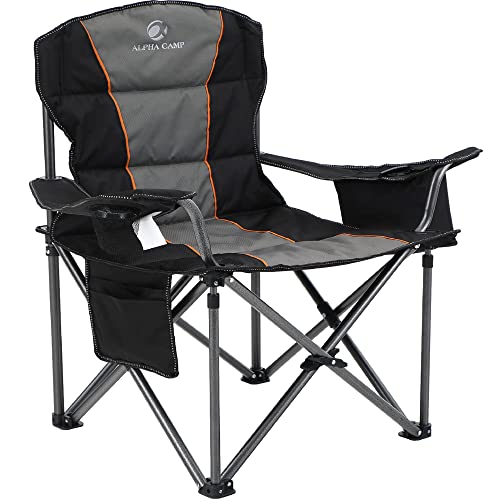
ALPHA CAMP Oversized Fully Padded Camping Chair
A long afternoon outside can make an undersized chair feel smaller by the minute. Pressure along the hips, a sagging back, and a frame that shifts under movement can turn what should be downtime into constant repositioning. ALPHA CAMP tackles those headaches with a 24.8-inch-wide seat, full padding, reinforced steel construction, and a stated 500-pound capacity, putting it squarely among best big man folding camping chairs built around space and support rather than bare-bones portability. The chair isn't trying to disappear into a hiking pack; its priorities are much closer to roomy seating, steady support, and keeping everyday essentials within arm's reach.
ALPHA CAMP Oversized Padded Camping Chair
The 24.8-inch seating width is the first specification I'd pay attention to because extra room is one of the clearest reasons to move away from a standard camp chair. Narrow seats often pinch along the outer thighs or leave the frame rails uncomfortably close to the body, especially after an hour or two. ALPHA CAMP's wider seating area provides more lateral breathing room while the fully padded backrest adds cushioning behind the torso. That combination makes more sense for long fishing sessions, tailgates, campsite evenings, and backyard gatherings than a compact seat designed mainly around easy carrying.
Space alone wouldn't mean much if the chair felt nervous underneath, so the frame deserves equal attention. ALPHA CAMP uses a heavy-duty steel frame with reinforced cross-bracing and lists a 500-pound support capacity. Cross-bracing helps distribute load through several structural points rather than leaving a couple of legs to handle every shift in body position. That can make sitting down, leaning sideways, and getting back up feel more settled than they do in a lightly built folding chair.
The metal also carries an anti-rust coating, a sensible feature for equipment that may spend time around morning dew, damp grass, beaches, or changing weather. No coating makes careless storage harmless, of course, and putting any steel chair away wet is asking for trouble over the long run. Wiping off dirt and allowing the frame and fabric to dry before storage is still the smart routine. The coating simply gives the structure another layer of protection against the sort of moisture outdoor furniture inevitably encounters.
There is an unavoidable tradeoff here: a generously padded steel chair takes up more room than a minimalist folding stool. That's not really a flaw if the chair travels from a trunk to a campsite, from a garage to the yard, or from the parking area to a sports field. Comfort-first dimensions make less sense for backpacking, where every ounce and inch of packed volume matter. ALPHA CAMP fits much better into outings where sitting time is long and carrying distance is relatively short.
Full Padding Makes Long Sessions Easier
Plenty of oversized chairs solve width but leave the sitter resting against tightly stretched fabric. ALPHA CAMP goes another direction with a fully padded backrest, which spreads cushioning across a larger contact area instead of concentrating it around a small head pillow. That's useful once a quick break becomes a two-hour conversation around the fire. More padding won't magically correct every posture problem, but it can soften the pressure points that make thin sling-style chairs tiring over time.
The wide seat complements that back padding in a way that's easy to understand. A roomy lower section lets the hips sit without feeling boxed in, while the cushioned back gives the torso somewhere softer to settle. The resulting setup has a more relaxed character than compact event seating, particularly for extended outdoor sitting. That distinction matters at ball games, fishing spots, and tailgates where standing every few minutes isn't really part of the plan.
Padding does bring a weather-related compromise. Thick fabric usually retains more warmth than large mesh panels, so a fully padded chair may feel less airy during a hot, humid afternoon. The supplied information doesn't mention extensive ventilation sections, which means I'd treat cushioning as the priority rather than assuming breezy summer performance. Cooler evenings and mild-weather camping play more naturally to that design choice.
Cleaning also deserves a practical mention because outdoor chairs rarely stay spotless for long. ALPHA CAMP specifies 600D Oxford fabric that is tear-resistant and easy to clean, a sensible material choice for dirt, crumbs, grass, and the occasional spilled drink. The fabric's rugged construction suits repeated folding and outdoor use better than delicate upholstery would. Still, wiping spills before they soak into the padding will make maintenance easier, especially before the chair goes back into its carry bag.
A Frame Built For More Than Static Sitting
Weight capacity numbers can grab attention, but real chair stress isn't limited to sitting perfectly still in the middle of the seat. People lean toward coolers, push down while standing, shift toward one armrest, and occasionally drop into a chair harder than intended. The reinforced cross-bracing matters because those everyday movements send force through the structure from different angles. A 500-pound stated capacity provides useful context for how ALPHA CAMP positions the chair, but the reinforced architecture is what makes the specification more meaningful.
The steel frame also fits the chair's broader personality. This isn't a featherweight piece of outdoor furniture designed to save ounces at any cost; it's an oversized support-focused chair built for campgrounds, parks, beaches, fishing spots, and lawns. Steel tends to make sense in that setting because structural rigidity matters more than ultralight packing. The downside, naturally, is that heavier-duty construction rarely feels as effortless to carry as a tiny aluminum or fabric stool.
ALPHA CAMP offsets that limitation with a folding layout rather than pretending the chair is something it isn't. The frame sets up and folds without tools, which means there are no loose components to assemble after arriving at a campsite or event. Open it, put it where you want it, and the basic setup is done. That simplicity matters more than elaborate mechanisms because outdoor seating gets used precisely when nobody wants another assembly project.
Durability also depends on the relationship between fabric and frame. The 600D Oxford material is described as tear-resistant, while the cross-braced steel structure handles the mechanical load underneath. Those two elements address different failure points: fabric needs to withstand repeated tension, while the frame needs to resist flex and collapse. Together, they make more sense than focusing only on a large capacity number without considering the material supporting the sitter.
Cooler Storage Keeps The Ground Less Cluttered
Camp chairs somehow become small command centers once everyone settles in. A phone lands on one arm, snacks end up beside a shoe, and a cold drink inevitably gets placed on uneven dirt where one careless kick can finish it off. ALPHA CAMP includes a side cooler bag for three to four cans, a large cup holder, and a side storage pocket to keep those little necessities organized. None of these additions changes the core sitting experience, but together they remove several routine annoyances.
The cooler has a clearly stated three-to-four-can capacity, which is useful because it sets realistic expectations. It's meant for keeping a handful of drinks nearby, not replacing a family-size cooler full of food and ice. That scale works nicely for fishing, a long sports event, or an evening around a fire where leaving the chair repeatedly gets tedious. Small integrated storage is often more convenient than hauling a separate cooler for every short outing.
The large cup holder gives another dedicated resting place for a drink while the side pocket handles flatter items such as phones, maps, or snacks. Keeping electronics off damp ground is especially handy, and a pocket also prevents keys from disappearing beneath blankets or other gear. The supplied description doesn't provide exact pocket or cup-holder dimensions, so very large bottles shouldn't be assumed to fit. Still, having separate storage zones is more practical than making one tiny pocket handle everything.
Those conveniences become more noticeable the longer someone stays seated. At a tailgate, campsite, or backyard gathering, within-reach storage means fewer interruptions simply to retrieve a phone or grab another drink. That fits the chair's overall design philosophy nicely: it isn't chasing novelty, but it keeps adding small features that make extended sitting less fussy. Frankly, that's more useful than decorative details that look interesting but solve no actual problem.
Folding Design Keeps Transport Manageable
Big chairs can become awkward fast once the event is over and everything has to fit back into a vehicle. ALPHA CAMP's foldable frame collapses without tools and comes with a heavy-duty carry bag equipped with a shoulder strap. That won't turn an oversized padded seat into ultralight gear, but it does make the bulk easier to control. A contained chair is simpler to load beside tents, coolers, fishing equipment, or sports bags than an exposed frame with loose fabric flopping around.
The shoulder strap matters most during those medium-distance carries where the campsite or field isn't quite beside the car. Moving a full-size chair by hand can become annoying when other gear already occupies both arms, so hands-friendlier transport is a worthwhile feature. The description doesn't provide the chair's actual weight or folded dimensions, so it's better not to guess how light or compact it feels. What is documented is the quick folding mechanism and included carrying solution.
Different kinds of trips put very different demands on packing space. Soft luggage has its own storage priorities, and a separate example can be seen in best foldable duffle bag for checked luggage, where collapsibility serves travel rather than outdoor seating. ALPHA CAMP applies the folding idea to a bulkier piece of equipment whose open size matters for comfort. The useful distinction is that the chair folds for transport, but its main purpose remains generous stationary seating once it's opened.
Beach and park use fit the same pattern. The carry bag keeps the chair bundled between the vehicle and the sitting spot, then the tool-free setup gets it ready without fiddling with poles or separate pieces. Sand, mud, and moisture still deserve some care because the product information doesn't claim specialized sand feet or total weather immunity. A quick cleanup before packing protects both the Oxford fabric and the coated steel frame from unnecessary grime.
Who Will Appreciate The Extra Room Most
The biggest practical strength is how the chair combines a 24.8-inch seat with a reinforced 500-pound-rated structure. Someone who has spent time in narrow folding chairs knows that capacity and comfort aren't the same thing; a chair can technically support weight while still squeezing the hips or leaving the shoulders tense. ALPHA CAMP addresses both sides of that problem by giving the body more room and strengthening the structure beneath it. That combination is much more relevant than capacity alone.
The fully padded construction also favors outings where the chair stays occupied for long stretches. Fishing, tailgating, backyard gatherings, and camping often involve hours of intermittent sitting rather than short rests between walking. Broad cushioning and a wide seat make sense in those settings because small discomforts have plenty of time to build. A quick picnic stop wouldn't make full use of the design, but a three-hour ball game probably would.
The weaker side of the equation is portability for demanding travel. Extra width, steel reinforcement, full padding, a cooler, and storage pockets inevitably create more physical substance than a stripped-down trail chair. The description doesn't provide a product weight, so calling it light would go beyond the supplied facts. For anyone whose priority is covering miles on foot, packed efficiency is the obvious compromise behind all that comfort.
Within best big man folding camping chairs, ALPHA CAMP makes a straightforward case based on usable space rather than gimmicks. The 500-pound support rating, 24.8-inch-wide seat, reinforced cross-bracing, 600D Oxford fabric, full padding, three-to-four-can cooler, and integrated storage all address recognizable outdoor frustrations. It suits situations where the chair can travel folded, stay planted for a while, and provide more room than an ordinary folding seat. The design gives up some minimalist appeal, but that trade makes sense when cramped seating is the problem you're trying to leave behind.
Overmont Oversized Camping Chair 500lb
A chair can carry a big weight rating and still feel miserable if the seat pinches, the back sags, or the armrests bunch inward after twenty minutes. Overmont takes a more balanced approach by pairing a 500-pound support rating with roomy padded seating, reinforced joints, and practical storage instead of relying on capacity alone. That puts this model comfortably in the discussion around best big man folding camping chairs, particularly for long campfire evenings, fishing sessions, sports sidelines, or backyard gatherings. Its 11-pound weight also keeps the whole package from becoming an awkward piece of furniture that nobody wants to move.
Overmont Oversized Camping Chair 500lb
The dimensions tell you more about daily comfort than a vague oversized label ever could. Measuring 23.2 inches deep, 22.8 inches wide, and 39.4 inches high, the chair gives the body a generous sitting area without stretching into the proportions of a permanent patio recliner. That width helps reduce the squeezed feeling common with narrow folding seats, while the deeper profile gives the thighs more surface to rest on. For a long afternoon outside, those extra inches can matter far more than another decorative pocket or logo.
Overmont supports that larger sitting area with a powder-coated alloy steel frame and reinforced joints. The listed 500-pound capacity places it firmly in heavy-duty territory, but the structural details are what make that number more meaningful. Weight shifts constantly during normal use as someone leans for a drink, pushes up from the armrests, or turns toward a conversation. Reinforcement at the joints helps the chair deal with those less predictable forces instead of handling only a centered, motionless load.
The feet add another practical piece to that stability story. Overmont uses non-slip feet intended for grass, packed dirt, and other firm outdoor surfaces, which can help reduce unwanted movement while getting in or out. That doesn't mean the chair will behave identically on every patch of ground, especially loose sand or soft mud. Still, wider support expectations and a substantial steel frame make more sense for campgrounds and lawns than a lightly built chair with narrow contact points.
There's a refreshing bit of restraint in the overall concept. The chair isn't pretending to be a featherweight backpacking seat, yet at 11 pounds it doesn't land in the extremely heavy end of oversized camp furniture either. That's a useful middle ground for trips where the chair moves from a trunk to a campsite or from parking to a sports field. Carrying it for miles would be another matter, but that's clearly not the job this design is trying to do.
Padding Changes How The Chair Feels Over Time
Thin fabric can feel perfectly acceptable during a five-minute break and surprisingly unforgiving by the end of a game. Overmont uses double-layer 600D Oxford fabric with sponge padding, giving the chair more cushioning across both the seat and high back. That layered construction spreads contact over a broader area instead of leaving the body resting directly against a tightly stretched sling. The difference becomes more relevant the longer the sitting session lasts.
The fully padded high back is especially useful for anyone who dislikes camp chairs that stop low behind the shoulders. More back coverage lets the upper body settle against the chair instead of hovering forward, and the cushioning softens the contact point. Toss in the cushioned armrests and the overall posture feels less bare-bones than a simple event chair. Well, that extra comfort comes with a little more bulk, but that's the sort of trade most comfort-first seating makes.
Warm weather exposes the other side of padded construction. Sponge-backed Oxford fabric generally won't feel as airy as a chair built around large mesh ventilation panels, and the supplied description doesn't claim otherwise. Padding is the priority here, so hot midsummer afternoons may feel warmer than they would in an open-mesh design. Cool evenings, shaded campsites, sports events, and shoulder-season trips fit the chair's comfort profile more naturally.
The fabric itself is built for repeated outdoor handling rather than delicate indoor treatment. Overmont specifies reinforced stitching alongside the double-layer 600D material, which matters because seams endure a lot of tension during sitting, folding, and transport. Dirt and occasional spills are inevitable, so wiping the surface before packing it away will help keep the padding from storing grime or moisture. A little basic care goes a long way with any chair that spends weekends around dust, grass, food, and drinks.
Armrest Adjustment Adds Useful Flexibility
Armrests often get overlooked until they're sitting at exactly the wrong height. Too low, and the shoulders tend to roll forward; too high, and they can feel shrugged upward for hours. Overmont adds adjustable armrest straps, allowing the arm position to be tuned rather than fixed permanently by the chair's fabric geometry. That's a modest feature on paper, but it can have an outsized effect on how natural the sitting position feels.
The adjustable straps also help support the padded arms so they don't simply collapse inward under their own fabric weight. This matters during the routine motions of sitting down and getting back up, especially when the arms become natural contact points for the hands. Better arm positioning won't turn a camp chair into an ergonomic office chair, and it shouldn't be expected to. It does, however, give the sitter more control than a one-position sling design.
That flexibility pairs nicely with the high back. Upper-body comfort isn't controlled by one feature in isolation; back angle, arm height, seat depth, and padding all influence how the body settles after an hour. Overmont's high-back layout and adjustable arms work together to make small posture changes easier without requiring someone to constantly scoot around. For fishing or sideline use, that kind of adjustability is more meaningful than flashy extras that rarely affect actual sitting.
Personal preference still matters. Some people want rigid hard armrests for leverage, while others prefer padded fabric arms that feel softer against bare skin. Overmont clearly leans toward the cushioned side, so anyone who prioritizes solid molded arm supports should recognize that distinction. The strength here is soft adjustable support, not hard furniture-style arm construction.
Cooler And Storage Keep Small Gear Organized
A long outdoor session usually creates a little pile of stuff around the chair. Phones, sunscreen, keys, snacks, and drinks somehow migrate onto the ground unless the chair gives them somewhere better to go. Overmont includes a built-in insulated cooler bag, mesh cup holder, side pocket, and rear storage pocket to keep those small essentials separated. It's not fancy, but it cuts down on the constant bending, searching, and reshuffling that happens around busy campsites.
The cooler bag is particularly useful because it keeps cold drinks attached to the seating area instead of requiring another small bag beside the chair. The supplied description doesn't state its exact can capacity, so assuming a particular number would be a stretch. What we can say is that it provides insulated nearby storage for beverages without asking someone to stand up every time they want another drink. That's handy during ball games, fishing, or slow evenings around a fire.
The mesh cup holder handles the drink that's already open, while the side and rear pockets tackle the smaller clutter. A phone can stay away from damp grass, sunscreen doesn't have to disappear under a towel, and keys are less likely to vanish beneath other gear. Multiple storage zones also make more sense than one oversized catch-all pocket where everything ends up piled together. Each item gets a reasonably logical home instead of sharing the same cramped space.
Rear storage is especially useful for things that don't need constant access. A small map, light layer, magazine, or extra snack can sit behind the chair while the side pocket stays reserved for items used more often. That separation supports the chair's broader personality: it is designed for long, stationary outdoor use where keeping essentials close becomes part of comfort. Small conveniences rarely sell a chair on their own, but they can make a good seating setup noticeably easier to live with.
Folding Size Makes The Bulk Easier To Handle
Oversized seating becomes less appealing if it turns packing day into a wrestling match. Overmont folds to approximately 40 x 7 x 7 inches, creating a narrow bundled shape that fits into the included carry bag. That folded length is still substantial, but the seven-inch width and depth help the chair slot alongside tents, umbrellas, coolers, or other long gear rather than occupying a large rectangular chunk of cargo space. No assembly is required once it comes back out.
The chair's 11-pound weight also keeps transport relatively reasonable for this class of seating. Carrying eleven pounds from a parking area to a campsite is a very different proposition from hauling a bulky chair that approaches the weight of a small cooler. The included carry bag keeps the frame contained and makes storage less awkward between trips. Of course, 11 pounds still isn't ultralight, so hiking-focused trips remain outside its natural comfort zone.
Packing priorities can shift dramatically once outdoor gear shares space with luggage, especially on longer trips where every bag has to earn its footprint. A separate example of that space-conscious thinking appears in best carry on luggage for elderly, where manageable dimensions serve a different travel need. Overmont's folded 40 x 7 x 7-inch shape follows its own version of the same practical idea: large where comfort matters, narrower once storage takes over. The products aren't substitutes for one another, but compact handling plays an important role in both situations.
The folding mechanism also removes one of the tedious parts of camp setup. There are no separate legs to attach, bolts to tighten, or fabric panels to stretch into place because the chair opens and closes without assembly. That simplicity is valuable after a long drive when the last thing anyone wants is another piece of equipment demanding instructions. Fold it out, position it on firm ground, and the chair is ready for its actual job.
Where The 500-Pound Build Makes The Most Sense
The 500-pound support capacity is useful, but I'd never judge this chair by that number alone. Capacity says something about intended loading, while comfort comes from a separate mix of width, depth, back support, padding, and arm placement. Overmont does a good job of addressing both sides with a 22.8-inch width, 23.2-inch depth, high padded back, and reinforced alloy steel frame. That's much more useful than slapping a large number on a cramped seat and calling the job finished.
Grass and packed dirt are natural settings for the chair because the listed non-slip feet and steel frame are designed around firm outdoor surfaces. Campsites, backyard lawns, sports fields, and established fishing areas all fit that pattern. Loose beach sand may require more care because the specifications don't mention oversized sand feet, and there's no point pretending otherwise. Firm-ground stability is the documented strength here.
The chair also makes sense for outings where sitting dominates the schedule. Fishing can involve long stretches in one position, sporting events may run for hours, and a backyard gathering can easily drift late into the evening. In those circumstances, full padding and high-back support have time to prove their worth. A quick roadside stop wouldn't reveal much of the benefit, but repeated long sessions certainly would.
Its limits are fairly easy to understand. Anyone chasing the smallest packed dimensions, maximum airflow, or an ultralight trail setup will probably see the padding and steel frame as unnecessary baggage. Overmont instead favors room, cushioning, and heavy-duty support, while accepting that the folded chair remains about 40 inches long. That's a reasonable exchange for vehicle-based camping and event use, but it's still an exchange worth recognizing before buying.
Strengths And Tradeoffs That Actually Matter
The chair's strongest feature isn't really a single specification. It's the way 500-pound support, reinforced joints, a roomy padded seat, and an 11-pound carry weight intersect without one completely undermining the others. Heavy-duty chairs can become cumbersome, while lighter chairs sometimes sacrifice seating room or structural confidence. Overmont lands between those extremes with dimensions that favor comfort and a folded format that's still practical for vehicle transport.
Storage is another clear strength because the chair doesn't make one pocket handle every task. The cooler bag, cup holder, side pocket, and rear pocket separate drinks from personal items and reserve space for gear that doesn't need constant access. That setup becomes genuinely useful after a few hours outdoors, particularly when the ground is wet or cluttered. It's a thoughtful supporting feature rather than the main reason the chair exists.
The biggest compromises come from padding and size. A fully cushioned high-back chair can hold more heat than mesh seating, and a 40-inch folded length won't suit tiny storage compartments as easily as a compact stool. Those are real comfort-versus-portability tradeoffs, not defects that can somehow be designed away without changing what the chair is. Knowing where it will be carried and stored matters almost as much as knowing how much weight it supports.
Among best big man folding camping chairs, this Overmont makes a practical case for itself through numbers that actually explain the design. The 23.2 x 22.8 x 39.4-inch dimensions, 500-pound rating, powder-coated alloy steel frame, reinforced stitching, sponge padding, adjustable armrest straps, and 11-pound weight all point toward a roomy chair that remains manageable around the car, campsite, field, or backyard. It won't replace a lightweight hiking seat, nor should it try. Its better role is giving long outdoor sitting enough space, cushioning, and structure that the chair stops being the uncomfortable part of the day.


8 Best Folding Picnic Camping Table of 2026 For Stable Outdoor Dining
9 Best Travel Camping Table of 2026 For Uneven Ground
12 Best Heavy Duty Camping Table of 2026 That Will Not Wobble or Sag
8 Best Camping Table Adjustable Legs of 2026 for Uneven Ground

9 Best Adjustable Height Camping Table of 2026 For Uneven Ground

10 Best Adjustable Camping Table of 2026 For Uneven Ground
10 Best Waterproof Camping Table of 2026 For Rain-Ready Campsites

11 Best Folding Bamboo Camping Table of 2026 For Uneven Ground