
Do You Need a Power Adapter or Voltage Converter?

Most travelers need a plug adapter, a voltage converter, or both, depending on their devices. A plug adapter changes the plug’s shape, while a converter changes the strength of the electricity reaching a device.
Check the plug shape used at your destination and the voltage range printed on each charger or appliance. Some devices work with more than one voltage, but others may be damaged by the wrong supply. Heat-producing appliances need extra care because their power needs can be higher. Here’s how to check what each item in your carry-on can safely use.

- TLR Rank8.9
TLR Rank is a ranking system developed by TravelLuggageReviews.com. TLR Rank has no relationship or impact from any manufacturers or sales agent websites. Learn more
- BrandBESTEK

- TLR Rank9.3
TLR Rank is a ranking system developed by TravelLuggageReviews.com. TLR Rank has no relationship or impact from any manufacturers or sales agent websites. Learn more
- BrandKey Power
- TLR Rank7.7
TLR Rank is a ranking system developed by TravelLuggageReviews.com. TLR Rank has no relationship or impact from any manufacturers or sales agent websites. Learn more
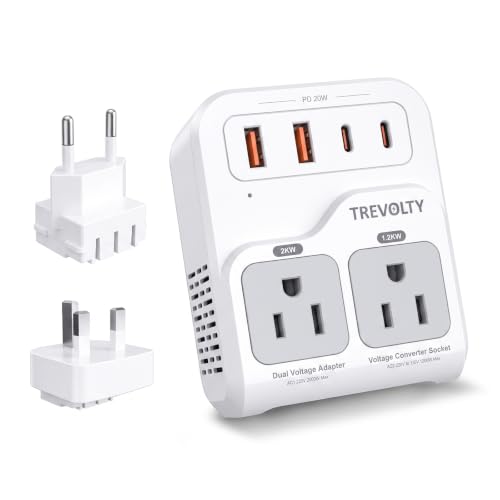
- BrandTREVOLTY

- TLR Rank7.4
TLR Rank is a ranking system developed by TravelLuggageReviews.com. TLR Rank has no relationship or impact from any manufacturers or sales agent websites. Learn more
- BrandLINGPEI

- TLR Rank7.3
TLR Rank is a ranking system developed by TravelLuggageReviews.com. TLR Rank has no relationship or impact from any manufacturers or sales agent websites. Learn more
- BrandTESSAN
Last update on 2026-11-13 / Affiliate links / Images, Product Titles, and Product Highlights from Amazon Product Advertising API
An adapter changes the plug shape, not the electricity
A plug adapter lets a plug fit into an outlet with a different shape. It does not change the strength of the electricity coming from that outlet. Think of it as a way to make two shapes fit together, not as a device that makes the power suitable for every appliance.
A voltage converter changes the strength of the electricity so a device can use it. You may need one if the outlet’s voltage is outside the range printed on your device. Some travel products combine an adapter and a converter, but you still need to check what each outlet on that product does.
The difference matters because a plug can fit while the electricity is still wrong for the device. That can damage the device or create a safety risk. Never assume that an adapter makes an appliance safe to use abroad.
Before packing, check the plug shape used at your destination and the label on every device you plan to plug into a wall. A phone charger, laptop charger, camera charger, and hair dryer can have different needs, even if you use them all at home.
Read each device label before you pack
Check the small print on the device, its charger, or its power supply. Look for a voltage range, which may be printed next to the word “input.” If the label is hard to read, check the device manual or the manufacturer’s instructions instead of guessing.
- Check the destination’s power. Confirm the outlet voltage and plug shape for the places on your itinerary. Countries, and sometimes regions within a country, can differ. Use a reliable travel or government source, or ask your hotel or host if you are unsure.
- Find the device’s voltage range. Read the full range on the label. A device marked for more than one voltage is called dual voltage, which means it can work with more than one strength of electricity.
- Compare the two. If the destination’s voltage falls within the device’s printed range, the device can generally accept that voltage. If the destination’s voltage falls outside the range, do not plug it in directly.
- Check frequency too. Frequency means how often the electricity changes direction. The destination’s frequency and the device’s label or manual should be compatible. Some devices are less affected than others, but do not assume a converter changes frequency. Check the converter instructions and the device maker’s guidance.
- Check what the device needs from a converter. If the voltage does not match, compare the device’s power needs with the converter’s stated limits. The converter must be suitable for that device, and its instructions must allow that kind of appliance.
A charger marked for a broad voltage range may work in more than one country without a voltage converter. You may still need an adapter if its plug will not fit the local outlet. The label, not the device’s brand or appearance, is what helps you decide.
Some labels show only a voltage and frequency, while others include more details. If the label is missing, rubbed off, or unclear, do not connect the device until you can confirm its requirements. Check the manual or contact the manufacturer. If you still cannot confirm compatibility, leave the device unplugged and ask a qualified electrical professional.
Match your packing choice to both checks
Once you know the outlet shape and the device’s needs, your choice falls into one of four situations. Check each device separately. The right answer for a phone charger may not be the right answer for a hair dryer.
- Adapter only: The device supports the destination’s voltage and frequency, but the plug does not fit the outlet. Pack an adapter that matches the destination’s outlet and your device’s plug.
- Converter only: The plug already fits, but the device does not support the destination’s voltage. A converter may be needed, but use one only if its instructions match the device’s power needs and type.
- Both: The device needs a different voltage, and its plug will not fit the destination’s outlet. You need a suitable converter and a way for the device’s plug to connect. A combined product may cover both needs, but verify what its sockets and settings do.
- Neither: The plug fits, and the device supports the destination’s voltage and frequency. You can connect it directly, following the device maker’s instructions.
For example, imagine a charger label that includes the destination’s voltage. If the charger’s plug shape does not match the wall outlet, you need an adapter, not a converter. If the plug fits and the label supports the local power, neither may be needed.
Now imagine an appliance whose label does not include the destination’s voltage. A simple adapter will not fix that mismatch. You would need to confirm that a converter is suitable for the appliance, or leave the appliance at home and use one provided at your destination.
Do not judge by whether a light turns on or a plug slides into place. A device may connect physically without being suited to the power. If a device becomes unusually hot, smells odd, makes an unexpected sound, sparks, or stops working, unplug it if you can do so safely. Do not keep using it; contact the manufacturer or a qualified professional for advice.
Heat-producing appliances need extra care
Hair dryers, curling tools, irons, kettles, and similar appliances can use much more electricity than small chargers. A converter that works for a phone may not be suitable for a heat-producing appliance. Check the appliance’s label and the converter’s instructions before packing or plugging anything in.
Look for the appliance’s power needs on its label or in its manual. Then compare them with the converter’s stated limits and any restrictions on appliance types. A converter’s watt limit is not the only detail that matters: its instructions must also allow the kind of appliance you plan to use.
Some travel adapters have separate outlets with different functions. One outlet may change voltage while another only lets a plug fit. Read the markings and instructions for the exact outlet you intend to use. Never assume that every socket on a combined product converts voltage.
If the label is unclear, or you cannot confirm that the converter supports the appliance, do not connect it. For a short trip, leaving a high-heat appliance at home is often the simpler choice. Ask your hotel whether it provides a suitable appliance, or use a device specifically made to support the destination’s power.
Do not use a converter if its cord, plug, or case is damaged, or if it becomes unusually hot. Keep electrical devices away from water and follow the product’s instructions about airflow and use. If you see sparks, smoke, or signs of melting, stop using the device and unplug it only if you can do so safely. Get help from a qualified professional if the outlet or wiring may be damaged.
Pack after checking every device
A few checks before you leave can prevent a useless charger or a damaged appliance from taking up space in your carry-on. Keep the device labels or manuals easy to find, especially if you are carrying a converter.
- Write down the plug shapes and power details for the destinations on your itinerary.
- Check the voltage range and frequency information for each charger and appliance.
- Pack destination-compatible plug adapters for devices that support the local power but have the wrong plug shape.
- Pack a converter only when a device needs a different voltage and the converter’s instructions confirm it can handle that device’s needs.
- Check whether a combined adapter and converter has separate outlets or limits. Follow the markings for the outlet you use.
- Leave an appliance unplugged if its label is unclear or its compatibility cannot be confirmed.
Keep the converter and its instructions together so you can check the limits at your destination. If you visit more than one country, repeat the outlet and voltage check for each stop. One adapter may not fit every outlet, and one converter may not suit every device.
Choose travel power gear only after checking your devices
A travel adapter or converter can help when it matches both the destination and the device. Before buying one, confirm the outlet shapes it supports, whether it changes voltage, which outlets perform that function, and the power limits and appliance restrictions in its instructions.
Do not rely on a product described as universal without checking its actual limits. A combined unit may offer a convenient way to connect several plugs, but it does not automatically make every device compatible. Match the product to the label on each device, and leave any appliance unplugged if the fit or power requirements remain uncertain.
Related guides: what to do if you need medical care abroad and do you need vaccinations before traveling abroad.


Best Affordable Carry On Luggage 2026 - 11 Most Loving

The 12 Best Carry On Luggage For Bad Back 2026 - Top Choices

Best Lightest carry on luggage with wheels in 2026

Top Airport Traveling Suitcases: Our 11 Best Picks

The Best Delsey Paris Luggage Set 2026

Top 10 Delsey Softside Luggage Picks for Stress-Free Travel

11 Best Guest Room Luggage Rack of 2026 To Protect Clean Bedding

11 Best Grom Luggage Rack of 2026 For Direct Bolt-On Fit










